
Kaiba, Garret and Ian just literally dig two years between the three when a printer saved their lives. Small was born with a rare and serious anomaly in the airways. For taking them forward, had to open up the trachea and immersing a tube that could breathe thanks to a mechanical ventilator. Its few months of life spent in an intensive care unit (ICU). Three years later, the children are already at home. All thanks to a splint printed that grew up with them until their tiny bronchi were strong enough to dissolve the implant alone.
With a 3D printer can print almost anything, from cars to a miniature version of the Eiffel tower. With a design program for your computer, the manufacture by layers offers the possibility to customize almost anything, an aspect that makes it very interesting for the medicine. Bones are already printed, dentures, cartilage ... But, with the children there are problem: they grow very quickly. For they need objects that, once printed, they can change with the time and adapt to its growth. It is the fourth dimension or printing 4D.
Green and his colleagues got the FDA, the federal agency in the USA which regulates and monitors drugs and medical devices, authorize an exception to the standard, to be able to test their ideas with a group of children. Small had been born with traqueobroncomalacia, an abnormality in the bronchi to be closed each time they breathe. Of the 30 that were located throughout the country, selected three whose lives were in greater danger.
"It is difficult to transmit the sick that were these children. The three had been in the Intensive Care Unit for months. At that time, needed a strong sedation, narcotics and paralysing", recalls Green. All three men made a tracheostomy in the neck to sit a breathing tube with artificial fans. "Still suffering from continuous episodes requiring resuscitation maneuvers," adds Dr. Green who, like his fellow adventure, has invested much of their money to verify the effectiveness of 4D printing to treat sick children.
Such degradation over time comes that neither painted children with traqueobroncomalacia. Condition able to kill them, the risk is disappearing as the small grows. From the three years, the bronchi have regained their strength and are able to do their work by themselves. So it is really just endure this time.
The problem is that, as explained in the journal Science Translational Medicine, there are no data on the rate of growth of the bronchi in the young children. That is why they needed a material that would grow with them. And it is another property of the splint that were printed. Attached to the exterior walls of each bronchus with suture, the material was followed by the call law quadratic-cube, adapting its shape and expanding its volume as the airways were widening.
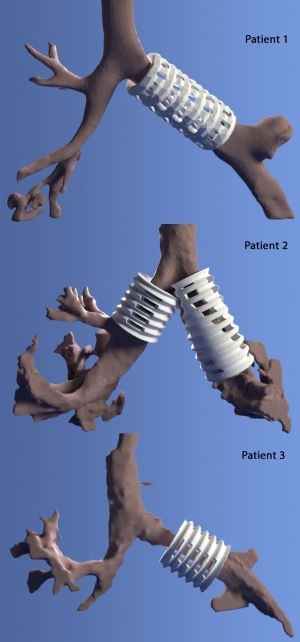 In addition, the digital design and 4D printing of biomaterials is a matter of
days, as shown in the case of Garret, that he was only 16 months when he made
the implant. In your case, had affected the two bronchi, so I need two splints.
"The two had to be placed in a small space where the trachea and bronchi are
joined. For this patient, we meet one Wednesday, we modified the program and
created the design on Thursday and printed the splints on friday to introduce
the following week. The development of a new device to have a splint implantable
took us three days," says Hollister.
In addition, the digital design and 4D printing of biomaterials is a matter of
days, as shown in the case of Garret, that he was only 16 months when he made
the implant. In your case, had affected the two bronchi, so I need two splints.
"The two had to be placed in a small space where the trachea and bronchi are
joined. For this patient, we meet one Wednesday, we modified the program and
created the design on Thursday and printed the splints on friday to introduce
the following week. The development of a new device to have a splint implantable
took us three days," says Hollister.